
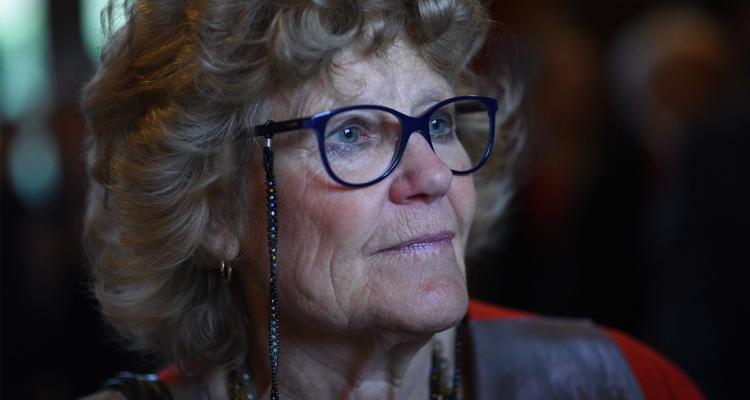
We are deeply saddened to announce the passing of Life Fellow, Dr Nancy Lane Perham OBE, who was a renowned microscopist and champion of women in science.
Nancy Lane Perham OBE FSB FRSA FRMS, born in 1936, was a Canadian cell biologist dedicated to teaching and research at the Department of Zoology, University of Cambridge specialising in cell-to-cell interactions, while also being a talented artist. Originally from Halifax, Nova Scotia, she attended Queen Elizabeth High School, where she was told that women could not be scientists, only lab technicians. Nancy went on to complete her undergraduate degree and a Masters of Science at Dalhousie University, where Professor Dixie Pelluet, a lecturer in invertebrate zoology and genetics, served as an important and supportive role model. After graduation, she was awarded the Imperial Order of the Daughters of the Empire scholarship and won the Governor General's Gold Medal, which allowed her to pursue doctoral studies at Oxford University. She completed her PhD in 1963 on cytological studies of secretory processes in gastropods, with special reference to neurosecretion.
After postdoctoral positions at Albert Einstein College of Medicine in New York and Yale University, in 1968, Nancy joined the Agricultural and Food Research Council (AFRC) Unit of Insect Neurophysiology and Pharmacology based in the Department of Zoology of the University of Cambridge as a Scientific Officer. When the Unit was dissolved in the late 1980s, she was incorporated into Department of Zoology. She continued with her research there while also teaching the Part II students in their important final year. She was a renowned microscopist, with research focusing on cell-to-cell interactions, such as gap junctions and tight junctions, especially in invertebrates. Over, her long research career she published more than 100 papers in a wide range of scientific journals.
When Nancy arrived in Cambridge in 1968, she was appointed to a Research Fellowship at Girton College and became an Official Fellow of the College in 1970. During her long career, she supervised many generations of Girton Natural Science students in the first and second year cell biology courses. From 1975 to 1998 she was also a Tutor for Girton’s postgraduate students. She was an inspirational teacher and mentor with a lifelong impact on many of her students, not only through her enthusiasm for biology but also due to her championing of careers for women and the feminist movement.
Nancy was a public advocate for women in science. She became the first Director of WiSETI, the initiative to support women in Science, Engineering and Technology (SET) in Cambridge. In addition to her work at Cambridge, she helped set up and run the UK Athena Project, which aimed to increase the participation of women in SET across the UK. She was asked by Prime Minister John Major to chair the Working Party on Women in SET after William Waldegrave's 1993 White Paper on the British science system, Realizing Our Potential, had devoted one whole paragraph to women, but noted that they were the single most undervalued human resource in Britain.
Besides her research, teaching and advocacy work, Nancy also used to paint. She focussed on the artistic portrayal of the structures and interactions of cells. Her works have appeared on journal covers and were selected to appear in the Royal Academy of Art's Summer Exhibition in 1995.
Nancy received honorary doctorates from six universities, including from the University of Surrey in 2005 and Heriot-Watt University in Edinburgh in 2015. She was awarded an OBE in 1994 for services to science and was inducted into the Nova Scotia Science Hall of Fame in 2006.
In 1969, she married Richard Nelson Perham, a distinguished biochemist who became Master of St John's College, Cambridge. They have two children, Temple and Quentin, who visited Girton often through the years for garden parties, family suppers and formal dinners.
Dr Lane Perham's career represents a remarkable achievement in overcoming gender barriers in science during an era when women were underrepresented in scientific careers. She helped lead Girton into a new era, bringing an outspoken and flamboyant presence to a College then shaped largely by more reserved fellows in the 1970s. Deeply committed to her students’ whole lives, she cared as much about their personal wellbeing as their academic success.
She leaves behind a legacy of inspiring and empowering women in science, and will be sorely missed by all who knew her, and not least by her friends and colleagues here at Girton College.
Tribute by Temple Perham Schauble, The Mistress of Girton, Ian Lewis, Abby Fowden and Sandra Fulton.