
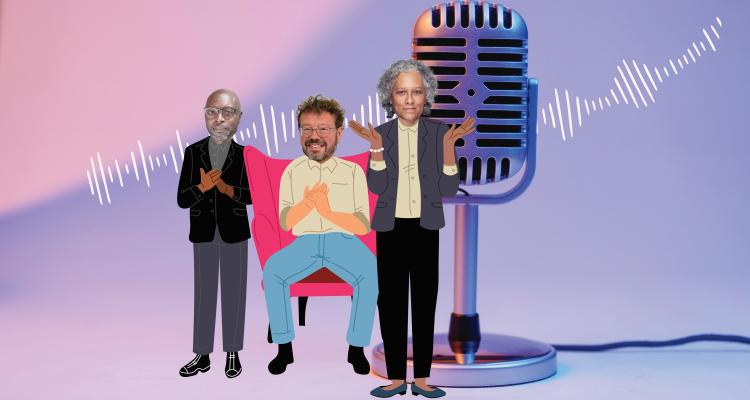
Pat Cumper (1973 Archaeology and Anthropology) has spent her career bringing stories to life in sound. In Jamaica, she wrote for one of the most popular radio soaps on the island, putting together around 250 episodes a year. In the UK, she created audio dramas for the BBC World Service, BBC Studios, and Radio 4, and adapted the works of legends such as Maya Angelou and Toni Morrison.
“It’s next to reading in terms of creating worlds in your imagination”, she says. “You can throw down some sails flapping and a few creaking boards, and suddenly, you’re at sea.” A few years ago, she started The Amplify Project, interviewing talented black writers about their approaches to writing. This gave her an opportunity to explore a slightly different form of audio storytelling: Podcasting.
“I remember thinking, ‘Oh wow, am I really allowed to do this? This is such fun.”
“There’s a strict discipline for 15-minute radio episodes. But here, you can actually let the subject breathe.”
“You don’t have to chop it down or have a producer phone you up to tell you what you’re expected to say. If someone says something interesting, you can just follow it.”
Freedom is a huge part of the appeal of podcasting. Creators can express themselves, without expensive equipment, extensive technical skills, or a broadcasting deal. Audiences have responded. Podcasts now have more than 584 million listeners worldwide, with an estimated 15.5 million in the UK alone in 2025. Successful podcasters are setting trends, starting conversations, and even influencing elections. So how is this mainstream attention re-shaping the format, and what’s next?
Democratising the audio space
Pat Cumper and co-founder Pauline Walker set up The Amplify Project to shine a spotlight on exceptional black writers who deserve more attention and encourage them to share what inspires and drives them.
The podcast turned out to be an ideal format for bringing those stories to life. “I remember one conversation with a writer”, Cumper says. “I asked them, ‘How do you look after your creative self?”, and they just burst into tears. And then I burst into tears as well, because no one cries alone around me.”
“That’s all in the podcast, because it’s a moment where the vulnerability shines through.” Cumper sees the show as less of an interview, and more of a “joint enterprise between you and the person you’re talking to”.
“Before this, I knew my writing process but didn’t really understand anyone else’s. Now, having sat down with so many writers, I’ve got a sense of how different writers work, and what helps and doesn’t help them.”
For Derren Lawford (1994 English and Social and Political Sciences) of UK indie studio DARE Pictures, that sense of conversation about a shared passion is a massive part of what makes a podcast work.
“The starting point is invariably something like, ‘I am really passionate about this thing, and I want to talk to other people who are equally passionate’. It’s unapologetic, and it’s not necessarily looking to attract people who aren’t interested, which is a bit of a distinction from what publishers, broadcasters and commissioners have to do.”
Before founding DARE Pictures in 2022, Lawford helped to set up BBC 1Xtra, and was the first multiplatform editor for BBC One’s Panorama. He’s worked with a dizzying range of stories in a variety of different formats, including TV, radio, journalism, and short-form content.
During lockdown, he put together a nine-part podcast series of his own. Original Pirate Material shared the story of Anthony ‘Tonz’ Cummins, and his decades-long life as a pirate.
“I was in the UK. My co-host was in Portugal, and the subject was in Italy. We recorded it on Zoom and got it out there. We pressed ‘record’, started talking, and away we went.
“It’s that sense of autonomy that people find really empowering. It’s a conversation that people are being invited to listen to, and that conversation could be about sexuality, wellness, politics, or how you manage ADHD. “Podcasts aren’t necessarily an easy way to get rich, but they can be an easy way to enrich your daily life.”
Making it work
Of course, in some cases, people have done very well indeed out of podcasting. Podcasts such as Parenting Hell, Off Menu, and The Diary of a CEO are household names in the UK. Podcast producer Goalhanger Productions totalled more than 400 million downloads in 2024, with titles such as The Rest is Politics, The Rest is Football, and The Rest is Entertainment.
In the USA, podcasts even helped to shape the 2024 election. Candidates Donald Trump and Kamala Harris saw podcasts as a way to reach the electorate, appearing on major shows such as The Joe Rogan Experience and Call Her Daddy.
“Podcasts are definitely part of a power shift in media”, says film, TV and digital producer and commissioner Adam Gee (1993 Modern and Medieval Languages).
“Joe Rogan is a prime example of that. An individual can amass and ‘own’ quite an audience, and your audience is your power. When you’re talking to that many people, then people will be interested in using your channel to reach the public.”
In February 2024, Rogan signed a $250 million contract with Spotify and now draws in millions of views per month. However, that’s not the reality for everyone. Statistics from Buzzsprout suggest that if a podcast gets more than 30 downloads per episode in its first week, that puts it in the top 50% of podcasts worldwide.
That’s not to say that you can’t make a living from a podcast. It’s just that – in many cases – it pays to think broader. “You can’t just rely on advertising”, says Gee. “There are other things like subscriptions, memberships, premium content, and so on, which are well worth considering.”
“However, what’s really exciting to me is that people are realising that they can do the podcast, the merchandise, and the live event, maybe launch a training programme, or some other publication. They’re working on many fronts, and when they’re all aggregated, you’ve got a chance of a viable project there that could fund itself.”
“I think that’s a really good example of how the era of digital has changed where value lies. When you’ve got a technology that can copy films, music, video, and images perfectly and without degradation, the value is in anything that’s not copyable. It’s in those unique experiences, like a music gig, a live podcast, or a performance - things that change from one day to the next and are never quite the same.”
Lawford points to the example of TellyCast, a TV industry podcast set up by Justin Crosby at the start of lockdown. “It was a way to connect with people about stuff in the industry and stay connected. Then it expanded into live interviews and became a festival about the industry. This year, they launched the TellyCast Digital Video Awards.
“It demonstrates that if you can harness people’s interests, you can take them with you to all sorts of places.”
The changing world of podcasts
Today’s podcaster needs to be versatile, savvy, and open to opportunities. On top of that, even the form itself is changing under their feet. YouTube is now, reportedly, the number one platform for podcast discoverability, and the use of video in podcasting is becoming more and more common. “Because a lot of podcasts are being distributed on YouTube now, they’re forming a different type of viewing experience”, says Lawford. “A lot of visual podcasts have a similar rhythm to the chat shows that you’d have seen in the 1970s and 1980s.”
Gee agrees that the move to video has been a “definite trend” over the last few years. “I always tended to listen to podcasts when I was running, or ironing, or doing stuff in the house”, he says. “My children’s generation – however – are more inclined to watch the video version of a podcast, but in a different, less concentrated way. That’s a really interesting trend, because it means that podcasting is becoming basically cheap TV.”
“On top of that, the medium is also struggling with the same problem as TV, in that there’s just tonnes and tonnes of it, throwing up the challenges of discoverability and audience retention.”
There are reportedly as many as 4.5 million podcasts available worldwide. That could be set to grow exponentially, with companies experimenting with podcasts generated by AI.
“I guess the issue around automation is that you could deprive podcasts of the very quality that made them exciting for people in the first place – unique and authentic voices”, says Lawford.
“If you can get an AI to say anything, how do you know which podcast is coming from a place of truth?”
The next chapter
So where do we go from here? Adam Gee has seen many shifts in his career, from his time as Multiplatform and Online Video Commissioner at Channel 4 to his new role as Head of Documentary Campus Masterschool in Berlin.
He says that, due to the pace of change “thinking about anything ten years ahead in this era of technology and media is a pointless exercise”. After all, ten years ago, the documentary podcast, Serial, was the standard-bearer of quality podcasting, and companies such as Gimlet and Wondery were developing intensive, expertly crafted audio stories. These companies were snapped up by Spotify and Amazon respectively during that “golden age” but have since faded from view. Gee notes that these types of podcasts were “massive research undertakings” and “inevitably quite expensive”.
But he sees potential for scripted, high-quality, “premium” podcasts to re-emerge as producers fight to gain attention. “My instinct is that we might well see premium productions come back as a way of differentiating from the sea of stuff that now exists, although it might not be in quite the same form.” DARE Pictures was set up to tell stories under the banner of ‘Diversity, Allyship, Representation, and Empowerment’. It’s going from strength to strength, winning Emerging Indie of the Year at the 2025 Broadcast Awards. For Lawford, it’s not so much about the medium, but the power of the stories you tell.
“When I launched DARE, my approach was to focus on story, people, and values, and then work out the form later. I was keen to find ideas that had the potential to be told in different ways. I try not to apply more weight to one form of storytelling than another, as sometimes the distinctions can be quite arbitrary.
“There are people who say you can only do TV if you know this stuff or do podcasts if you know that stuff. For me, stories are there to be told. If you can tell them, you should try and do so, by whatever means you can.”
Cumper hopes that podcasting can retain some of that “flexibility” and that “rebellious element”, and that it resists the temptation to become too rigid and “calcified”. However, she notes that podcasting still retains one of its most exciting and empowering traits.
“Anyone can put up a podcast. Nobody may listen to it, but anyone can do it. I’m interested in how the form evolves, because I love the fact that everyone can participate and potentially reach many other people.
“You can define your own rewards, and it doesn’t always have to be about getting half a million listeners.
“With our project, I feel a real pride, because we’ve done the best we can. And sometimes that’s the reward in doing something: Creating something that you feel should be done and doing it to the best of your ability.”