
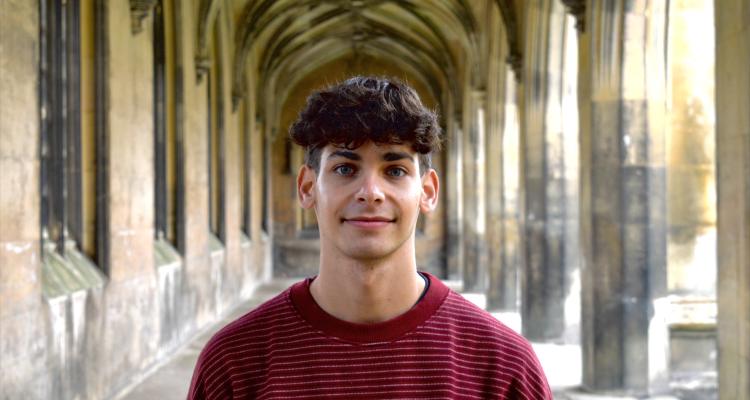
Our warmest congratulations go to Charlie Rowan, a History undergraduate at Girton College, who is the runner-up in this year's prestigious Trinity Hall Prize in Student Journalism. The Prize is the only journalism prize of its kind at Cambridge and recognises excellence in journalism among Cambridge students.
We caught up with Charlie on what this recognition means and how studying history influences the way he approaches journalism.
“I am delighted to be recognised for my reporting on Roshaan Khattak’s experience of transnational repression. It felt important to shine a light on a life-and-death issue that often goes unnoticed, and I am very glad the story had an impact. Student journalism is a vital tool for both accountability and storytelling – long may it prosper at Cambridge."
Can you tell us about the piece you submitted and what inspired it?
"I submitted my Varsity front-page piece from last January about Roshaan Khattak, a Cambridge postgraduate student and human-rights activist. He had received threatening messages online telling him that ‘Cambridge and the UK are not safe’ after he criticised alleged human rights abuses in Balochistan, a conflict-ridden region in Pakistan.
Khattak claimed the threats were linked to the ISI, Pakistan’s intelligence service, which, according to several reports, has a history of targeting dissidents abroad – a phenomenon known as ‘transnational repression’.
There was also an institutional dimension to the story. Khattak accused the University of failing to take adequate steps to protect him, saying he had asked his college more than fifteen times to meet and discuss security concerns but had been declined."
What was the central argument or story you wanted readers to take away?
"Although it was an impartial news piece, the central point I wanted readers to take away was that transnational repression is a real and ongoing threat, and that freedom of speech is not always guaranteed, even at universities. I wanted to shine a light on an issue that often goes unnoticed and, potentially, to use my platform as a Varsity journalist to hold the University to account."
How long did it take to research and write the piece?
"I first came across the story while searching on X/Twitter late last December and contacted Khattak shortly afterwards to arrange an interview. From there, I spent three weeks researching and reporting the piece.
That involved contacting multiple institutions for comment and right of reply – including representatives of the Pakistani state, the University, and the police – while trying to balance the human dimension of the story with careful, legally sound reporting.
The piece required the verification of a lot of detail and also working closely with Khattak on what information about him he felt comfortable sharing publicly."
How does studying history influence the way you approach journalism?
"Studying history has been incredibly valuable for my work as a journalist. At their best, the two disciplines are really two sides of the same coin. I think there’s truth in the old line that ‘journalism is the first draft of history’: journalism is essentially an attempt to chronicle the present as it unfolds.
Likewise, historical training teaches you to be aware of the subjectivity of interpretation, to verify facts rigorously, and to write clearly and persuasively – all skills that are central to good journalism. When I was Editor-in-Chief of Varsity last term, I actually found the transition between spending long days producing the newspaper and then writing history essays surprisingly natural because the underlying skills are so similar."
Do you think historical training gives you an advantage in investigative or analytical writing?
"Yes, definitely. Historical training teaches you to navigate archives and large bodies of evidence, to identify patterns, and to remain persistent in searching for overlooked sources. That mindset is incredibly useful in investigative journalism, where the goal is ultimately to uncover and relay fresh information."
Has this achievement impacted your future plans in any way?
"I’ve wanted to be a journalist since I was about fourteen, so I’m very grateful for this recognition from such a prestigious award. It will motivate me to keep going. Looking ahead, I hope to continue freelancing and reporting for national newspapers and media outlets during the rest of my degree, and after graduating to pursue a career in political journalism in Westminster."